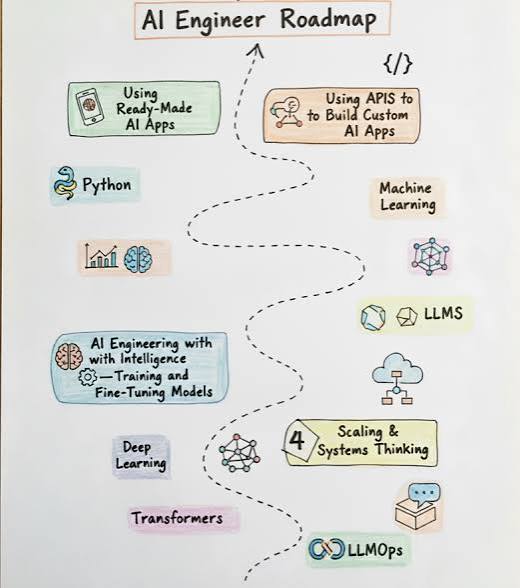
AI models are only as good as the engineers who build, deploy, and maintain them in the real world. Here's the case for becoming an AI engineer in 2026, and how Dazu Hub can help you get there.
Everyone's talking about AI. Far fewer people know how to actually build it — take a model from a research paper or an API into a working product that runs reliably at scale. That gap between "using AI" and "building AI systems" is exactly where AI engineers sit, and it's one of the most sought-after roles in tech right now. Here's the case for pursuing it in 2026, and how Dazu Hub can help you get there.
- Every Company Wants AI, but Few Can Build It Well
Businesses across every sector — finance, healthcare, retail, logistics — are trying to integrate AI into their products and operations. Most don't have in-house talent who can actually design, train, fine-tune, and deploy these systems responsibly. That gap is driving strong, sustained demand. - It's More Than Prompting — It's Systems Work
A lot of people can write a good prompt. Fewer people can build the infrastructure around it: data pipelines, model evaluation, fine-tuning, monitoring for drift, and integrating AI safely into a larger application. AI engineering is that deeper, more technical layer — and it's much harder to automate away. - You Sit at the Intersection of Software Engineering and Data Science
AI engineering blends software engineering skills (building reliable, scalable systems) with data science fundamentals (understanding models, data, and statistics). That combination makes you flexible — able to move between more technical ML work and more product-focused engineering work. - Agentic AI Has Created a Whole New Category of Work
As AI shifts from answering questions to autonomously completing tasks — booking, researching, executing multi-step workflows — engineers who understand how to design, test, and put guardrails around these agents are in especially short supply. - Strong Salaries and Career Ceiling
AI engineering consistently ranks among the highest-paid roles in tech, reflecting both the technical depth required and the current shortage of qualified people. It's also a role with a long runway — there's always a deeper layer of the stack to specialize in. - Responsible AI Skills Set You Apart
As regulation catches up with AI (like the EU AI Act) and companies face real reputational risk from AI mistakes, engineers who understand governance, bias, and safety considerations — not just model performance — are increasingly valued over those who only chase accuracy metrics. - Portfolio Work Is Genuinely Impressive
Projects like fine-tuning a model for a specific task, building a working AI agent, or deploying an ML pipeline end-to-end are strong, visible proof of skill — the kind of work that stands out clearly in interviews and portfolios.
Getting Started with Dazu Hub
At Dazu Hub, our AI Engineering course takes you from core Python and machine learning fundamentals through to building, deploying, and monitoring real AI systems — including agentic AI workflows — with hands-on projects you can showcase to employers by the end of the course.
Becoming an AI engineer in 2026 puts you at the center of the most consequential shift happening in tech right now. Join Dazu Hub and start building AI systems that actually work.